
| TECHNOLOGICAL CARD |
|


CONNECTORS
A: raw water, B: aerated water, C: compressed air, D: vent valve connection socket, E: reserve connector, F: revisory manhole
USE
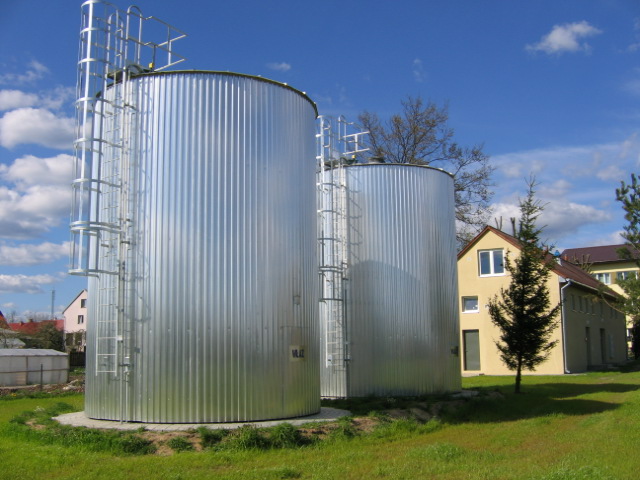
Hydropneumatic mixers are used for treated water aerating in order to facilitate precipitation of iron compounds. The mixers are necessary element of each water treatment system. They are to be used in collaboration with a set of filters in cold water systems at maximum permissible pressure PS=6bar and maximum permissible temperature TS=20°C.
In relation to traditional cascade mixers they have big productivity at small building surface. They are most often used when the building surface possibilities are limited. The flange connection which is used on the jacket makes them easy-to-operate and exploit - especially when cleaning is concerned.
MIXER CONSTRUCTION
All the basic mixer elements (jacket, elipsoidal bottom heads, manholes, connectors, screen, etc) are made of certified low-carbon steel. Pressure PS=6bar cannot be exceeded while operating the mixer.
Hydropneumatic mixer is a static aerator, in which water stream is counter-currently mixed with the compressed air given by the system of nozzles. The screen element, where the aerating head is installed, raises the efficiency of the aerating process.
The tank is internaly protected against to corrosion with "BRANTHO-KORRUX" paint with PZH certificate for contact with drinking water. Additionally the tank can be externaly painted with chlorinated rubber, polyvinyl or other paint in any colour. The mixers are also produced in a galvanized version.
The mixer ARC subjects to the instruction 97/23/WE (PED). According to it and according to the instruction 2/8 for PED the mixers are included to the devices from the area of art. 3, chart 4 (engineering practice). That's why the mixers don't have the CE sign.
NOTE!
1. Note: In case of the need to maintain the airbag in the mixer, tank is assigned a CE sgn.
BASIC MIXERS DIMENSIONS
| Type |
Nominal diameter DN [mm] |
Capacity V [m3] |
Total height H [mm] |
h3 [mm] |
Distance between the base and "B" connector's flange rebate h [mm] |
Connectors diameter dn [mm] |
Amount of nozzles in air supply system [szt.] |
Mass [kg] |
Recommended efficiency [m3/h] |
||
| A | B | A | B | ||||||||
| ARC 1 | 800 | 0,90 | 2550 | 2480 | 2024 | 400 | 100 | 4 | 255 | 265 | 15-30 |
| ARC 2 | 1000 | 1,50 | 2650 | 2580 | 2074 | 400 | 100 | 6 | 335 | 345 | 30-45 |
| ARC 3 | 1200 | 2,20 | 2750 | 2685 | 2124 | 400 | 150 | 8 | 420 | 430 | 40-65 |
| ARC 4 | 1400 | 3,15 | 2850 | 2790 | 2176 | 400 | 150 | 10 | 600 | 615 | 60-90 |
| ARC 5 | 1600 | 4,20 | 3000 | 2940 | 2276 | 450 | 150 | 10 | 790 | 810 | 80-120 |
| ARC 6 | 1800 | 5,50 | 3100 | 3040 | 2326 | 450 | 150 | 12 | 940 | 960 | 100-160 |
| ARC 7 | 2000 | 7,00 | 3800 | 3740 | 2828 | 550 | 200 | 12 | 1315 | 1355 | 140-200 |
| For the given parameters the tolerance shall be taken according to the existing rules. | |||||||||||